Quantify the positive and negative impacts

of your organization and investments

Reveal the societal and environmental footprint of your investments with our science-based, standardized, and data-driven approach – and benchmark the performance of your investments against industry averages and peers, just like EBIT.

PI Impact Accounting Framework, Impact Accounting Standard PI Value & Risk Framework, PI Strategy Framework PI Rahmenwerk zur Wirkungsbilanzierung, PI Wert & Risiko Rahmenwerk, PI Strategie Rahmenwerk

The PI Reference Path™ — a science-based benchmark trajectory — provides:

  • A science-based benchmark values for six topics and 14 indicators
  • A clear trajectory from 2020 to 2050 (and beyond)
  • Full value-chain coverage — from operations to upstream and downstream impacts
  • Benchmark the performance of your investments against peers and industry averages — to see exactly where you stand and where to improve
  • CSRD alignment — enabling fact-based, auditable, and legally sound materiality assessments across short-, mid-, and long-term horizons

Impacts are no longer abstract – they’re measurable

Regulations are evolving, stakeholders are watching, and climate urgency is real. Knowing your impacts isn’t just smart — it’s essential. Yet most tools stop at vague, qualitative insights that don’t drive decisions. Our Impacts Accounting Framework and Tool changes that without impact washing the results.

Independent of sector-focus or size, you gain a clear and comparable picture of where your investments stand, what’s required, and the path to creating positive impacts — turning impact data into real strategic action.

PI Impact Accounting Framework, Impact Accounting Standard PI Value & Risk Framework, PI Strategy Framework PI Rahmenwerk zur Wirkungsbilanzierung, PI Wert & Risiko Rahmenwerk, PI Strategie Rahmenwerk

our tools empower investors to

Identify financial effects, risks and opportunities
tied to the material impacts of your investments
Measure current impacts on
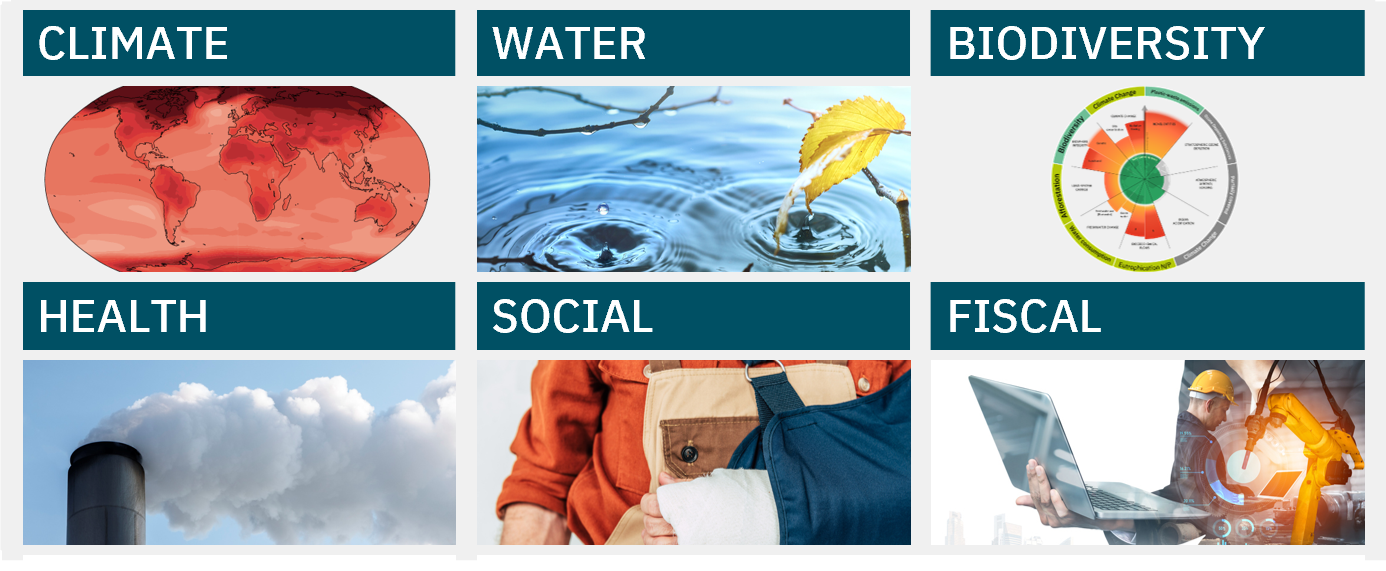
Topics covered by PI's Impact Accounting Framework
FORECAST future impacts 
based on strategies, trends, and set targets of your investments
benchmark
your portfolio or funds against industry average and peers
cross-sectoral
applicable across all industries and value chains
ACT with confidence
based on data and clear accounting rules – not assumptions

Measuring the positive and negative impacts of your investments

Built on internationally recognized science and methodologies, the PI Reference Path (PRP) enables you to quantify both positive and negative impacts of every investments — not just in theory, but in actionable, measurable terms. It covers the issues that matter most: climate, water, biodiversity, health, social, and fiscal.

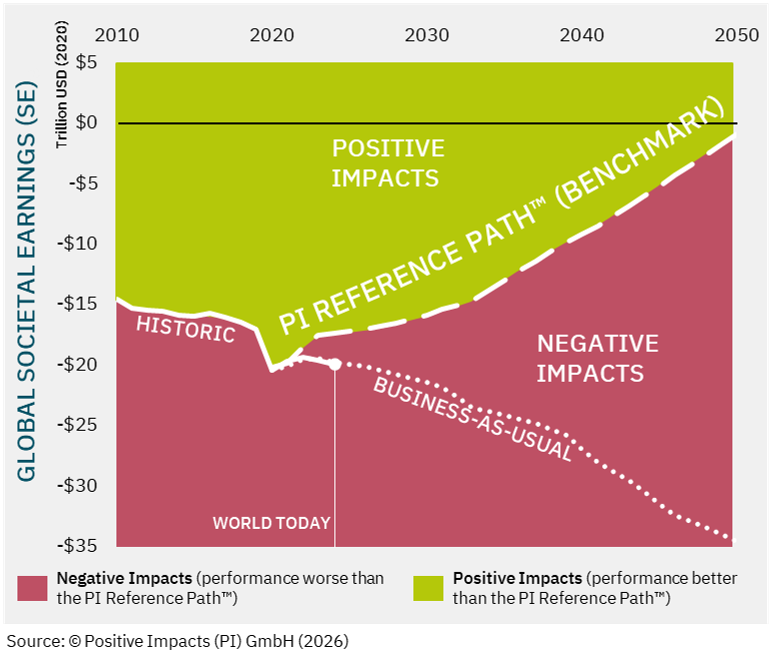
The PI Reference Path™…

The PI Reference Path™ shows the science-based trajectory toward net positive societal impact by 2050, allowing organizations to measure whether their impacts are positive or negative relative to the benchmark.

The PI Reference Path™ incorporates targets and data from authoritative sources — including IPCC, UNEP, Stockholm Resilience Centre, the UN Sustainable Development Goals, ILO, IMF and the OECD.


Why use the path? Standardization is what makes the tool powerful: it translates global sustainability goals into concrete thresholds for individual organizations — allowing you to track where you are today, forecast future impacts, and act with confidence.

Asset Owners/LPs

Intention: Incorporate ESG Impacts factors and sustainability goals into the long-term strategy

Challenge: Difficulty in quantifying sustainability Impacts (performance) and related long-term ESG risks and opportunities

Solution: Utilize PI’s Desired Impacts-Levels and Ambition Level Concept to determine overall investment strategies and conduct an Impacts-Level Forecast or a Strategy Stress test (external)/Due Diligence to assess sustainability Impacts, risks & opportunities, and strategy/governance gaps

Intention: Evaluate external asset managers’ strategic ESG integration capabilities
Challenge: Assessing managers’ sustainability understanding; distinguishing between asset managers who strategically manage the topic and those that don’t.

Intention: Continuously improve sustainability/ESG performance and integration, and maintain alignment with asset managers
Challenges:
> Lack of clarity on stewardship expectations
> Overemphasis on short-term performance
> Not taking enough account of stewardship outcomes which risk undermining longer-term sustainable growth

Solutions:
> Strategic engagement: Determine appropriate sustainability strategies for each investee to enhance their sustainability efforts and engage with them to ensure that they pursue them and use the PI KPIs to track and report your investor Impacts, using Strategy Stress test (external)/Due Diligence

> Integrated sustainability targets: Assess the level of alignment/ambition of sustainability targets set by portfolio companies to set targets for your portfolio, using Desired Impacts-Levels

Intention: Integrate sustainability/ESG Impacts & governance criteria alongside financial analysis
Challenge: Balancing sustainability/ESG priorities with financial performance expectations
Solutions:
> Investment strategy alignment check: Identify and assess potential investments for alignment with the overall sustainability goals of your organization using the Desired Impacts-Levels

> Integrated valuation & pricing: Quantify societal impacts of investments using Net Present Impact® to adjust valuations based on sustainability risks and opportunities by integrating sustainability-driven risks and opportunities into your valuations (NPV, Sharpe-ratio, etc.), using the Integrated ESGF Risk & Opportunity Assessment and Valuation

> Integrated decision-making: Inform investment decisions and portfolio rebalancing based on Desired Impacts-Levels and financial KPIs in the PI® Strategy Matrix

Intention: Track sustainability/ESG Impacts-Levels, guide and ensure a strategic sustainability management alongside monitoring financial indicators
Challenge: Lack of standardized sustainability/ESG data and metrics, as well as a lack of strategic sustainability management guides for consistent monitoring
Solutions:
> Identify & close data gaps for your portfolio on the KPIs of PI Reference Path™ using PI’s Advanced Data Modeling

> Sustainability Impacts-Level Forecast for portfolio industries:

> Evaluate portfolio industries’ current and forecasted Impacts-Levels based on trends of your portfolio and obtain a general understanding how much the portfolio companies are ‘on track’ compared to science-based targets (i.e., the PI Reference Path™)

> Identify assets to be assessed further in a detailed sustainability Impacts-Forecast

> Detailed sustainability Impacts-Level Forecasts for individual assets:

> Evaluate the forecasted Impacts-Levels of selected portfolio companies/assets based on existing plans, targets, and trends and understand how much selected portfolio companies are ‘on track’ compared to science-based targets (i.e., the PI’s Science-based Targets Path®)

> Identify potential risks and opportunities and determine investment strategies using the PI® Strategy Matrix

> Impacts Benchmark: Compare investees’ performance across sectors and against peers to identify investment opportunities and engagement strategies

> Sustainability activity monitoring: Track progress on Impacts-Levels across your entire portfolio in the PI® Strategy Matrix

Intention: Include sustainability/ESG metrics in performance reporting

Challenge: Complexity of sustainability/ESG regulations and reporting requirements

Solution: Utilize PI’s sustainability-context-based KPIs, namely Impacts-Levels for the past fiscal year as well as Net Present Impact® for standardized reporting across the portfolio

Intention: Continuously improve sustainability/ESG performance and integration, and maintain alignment with asset managers
Challenges:
> Lack of clarity on stewardship expectations
> Overemphasis on short-term performance
> Not taking enough account of stewardship outcomes which risk undermining longer-term sustainable growth

Solutions:
> Strategic engagement: Determine appropriate sustainability strategies for each investee to enhance their sustainability efforts and engage with them to ensure that they pursue them and use the PI KPIs to track and report your investor Impacts, using Strategy Stress test (external)/Due Diligence

> Integrated sustainability targets: Assess the level of alignment/ambition of sustainability targets set by portfolio companies to set targets for your portfolio, using Desired Impacts-Levels

Asset Managers/GPs

Intention: Design fund structures incorporating sustainability/ESG criteria
Challenge: Defining clear, measurable sustainability criteria for fund creation (focusing on risks, opportunities, or meeting sustainability goals)
Solutions:
> Utilize PI Ambition Level Concept to determine overall investment strategies

> Set fund-level sustainability objectives based on PI Reference Path™

Intention: Apply sustainability/ESG integration in investment decision-making
Challenge: Ensuring sustainability/ESG integration throughout the full investment lifecycle while existing ESG data is mostly incomplete and full of missing information
Solutions:
> Identify and close data gaps for your portfolio on the KPIs of PI Reference Path™ using PI’s AI-supported Data Modeling

> Conduct Strategy Stress test (external)/Due Diligence by identifying and assessing potential investments for alignment with the overall sustainability goals of the asset owner(s) or the fund(s), evaluating the target’s impacts, associated risks & opportunities, and gaps in its sustainability strategy

> Evaluate the current sustainability performance of potential investments by using Impacts-Level metrics

> Conduct a forward-looking Impacts Forecast for the investment lifecycle, calculating their Net Present Impact® (NPI®)

> Integrate valuation & pricing by using the quantified societal impacts of investments to justify premium pricing and adjust valuations based on sustainability risks and opportunities, using the Integrated ESGF Risk & Opportunity Assessment and Valuation for integrating sustainability-driven risks and opportunities into your valuations (NPV, Sharpe-ratio, etc.)

Intention: Actively monitor and manage sustainability/ESG impacts, risks, and opportunities (i.e., ongoing sustainability/ESG data management)
Challenge: Accessing reliable and up-to-date sustainability/ESG impacts data of your portfolio
Solutions:
In case your existing portfolio needs to be assessed:

> High-level Impacts-Level Forecast for portfolio industries:

> Evaluate portfolio industries’ current and forecasted Impacts-Levels based on trends of your portfolio and understand how much they are ‘on track’ compared to science-based targets (i.e., the PI Reference Path™) and industry averages, by using the Impacts-Level for the current and the Net Present Impact® (NPI®) for the projected Impacts Levels in % or Points

> Identify potential risks and opportunities and industries to be assessed further in the PI® Strategy Matrix

> Detailed Impacts-Level Forecast for individual assets:

> Update the forecasted Impacts-Levels of selected portfolio companies based on existing plans, targets, and trends and understand how much selected portfolio companies are ‘on track’ compared to science-based targets (i.e. the PI Reference Path™), by updating the Impacts-Level for the current and the Net Present Impact® (NPI®) for the projected Impacts-Levels in % or Points

> Identify or validate risks and opportunities and determine investment and engagement strategies in the PI® Strategy Matrix

> Perform Impacts-Level Benchmarks to compare investees’ performance across sectors and against peers (to identify investment opportunities and engagement strategies)

In case your existing portfolio was already assessed:

> Implement engagement strategies with investees based on their Impacts-Levels, using the Strategy Stress test (external)/Due Diligence

> Set integrated sustainability targets for the portfolio, i.e., a target informed by the NPIs of the individual portfolio companies

> Continuously update fund strategies using impacts, risk, opportunity and ambition to align with evolving sustainability standards while maintaining financial performance

> Implement integrated decision-making processes at the asset level by informing investment decisions and rebalancing the asset’s product/service portfolio based on both sustainability Impacts-Levels and financial KPIs in the PI® Strategy Matrix

> Monitoring: Track progress by comparing the expected Impacts-Levels to the achieved performance across your entire portfolio in the PI® Strategy Matrix while keeping track of the activities and actions initiated by you (in case you want to monitor and report your investor impacts)

Intention: Report on sustainability outcomes to investors
Challenge: Meeting diverse investor expectations for sustainability/ESG reporting
Solutions:
> Utilize PI’s sustainability-context-based KPIs for standardized reporting across the portfolio by leveraging Impacts-Levels for clear communication of the current sustainability Impacts-Level of your portfolio

> Use NPT® and NPI® to demonstrate forward-looking sustainability strategies and alignment with science-based targets, meeting diverse investor reporting needs

Intention: Continuously improve ESG impacts and strategy of individual investees
Challenge: Balancing investees’ financial performance with ESG-driven priorities
Solution:
> Engage with portfolio companies using your insights into Impacts-Levels and gaps to a strategic sustainability management that fits

Intention: Consider sustainability/ESG factors in exit strategies for individual assets or an overall fund
Challenge: Deciding the right time for a divestment. Quantifying the change in Impacts during the holding period and if desired the investor’s share of it as well as the forecasted Impacts (NPI®)
Solutions:
> Inform divestment decisions and portfolio rebalancing based on Impacts and financial KPIs in the PI® Strategy Matrix

> Conducting final Strategy Stress test (external)/Due Diligence to assess improvements during the holding period by calculating the change in Impacts

> Using NPI® in exit valuations, demonstrating tangible current and forecasted Impacts to potential buyers and leveraging the Integrated Value & & assessment and valuation approach to justify premium pricing based on quantified Impacts

Indicators

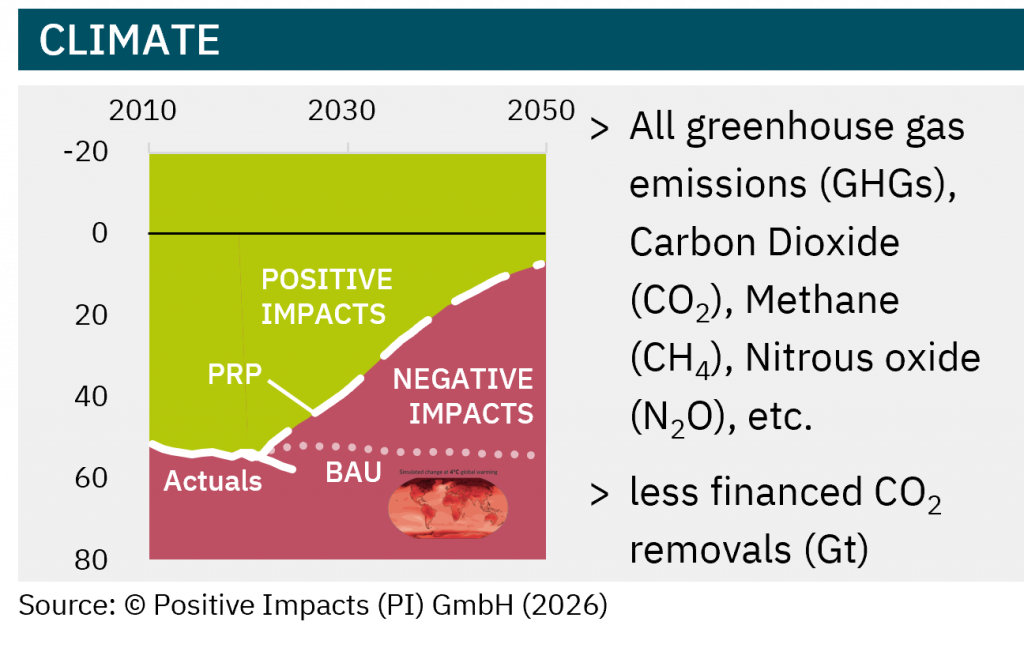
The PI Reference Path™ (PRP) for climate enables science-based measurement and benchmarking of positive and negative climate impacts.
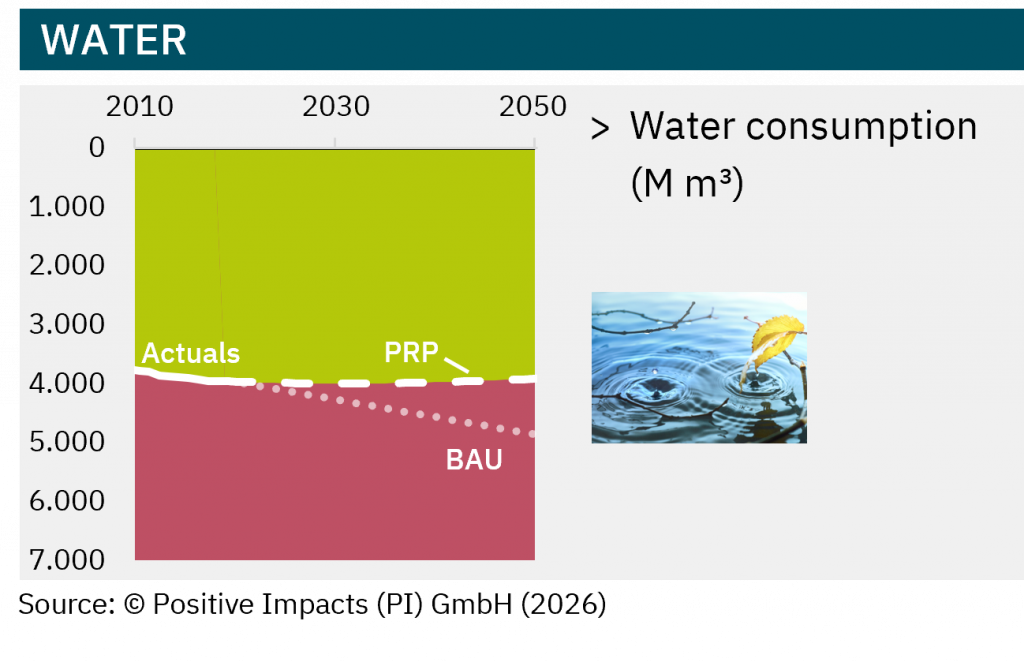
The PI Reference Path™ (PRP) for water enables science-based measurement and benchmarking of positive and negative water impacts.
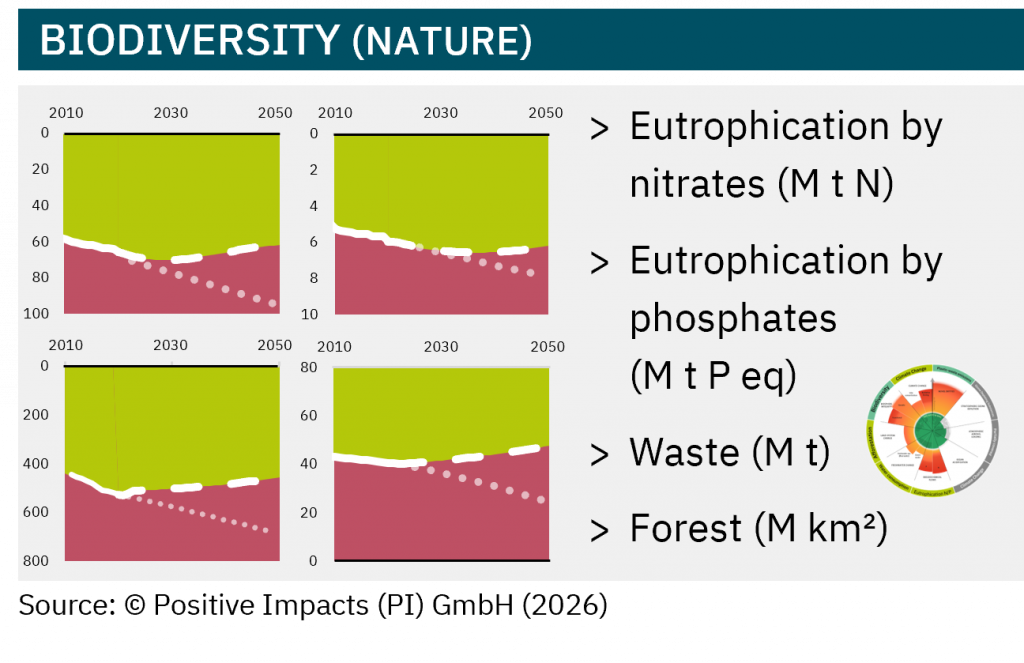
The PI Reference Path™ (PRP) for biodiversity enables science-based measurement and benchmarking of positive and negative biodiversity impacts.
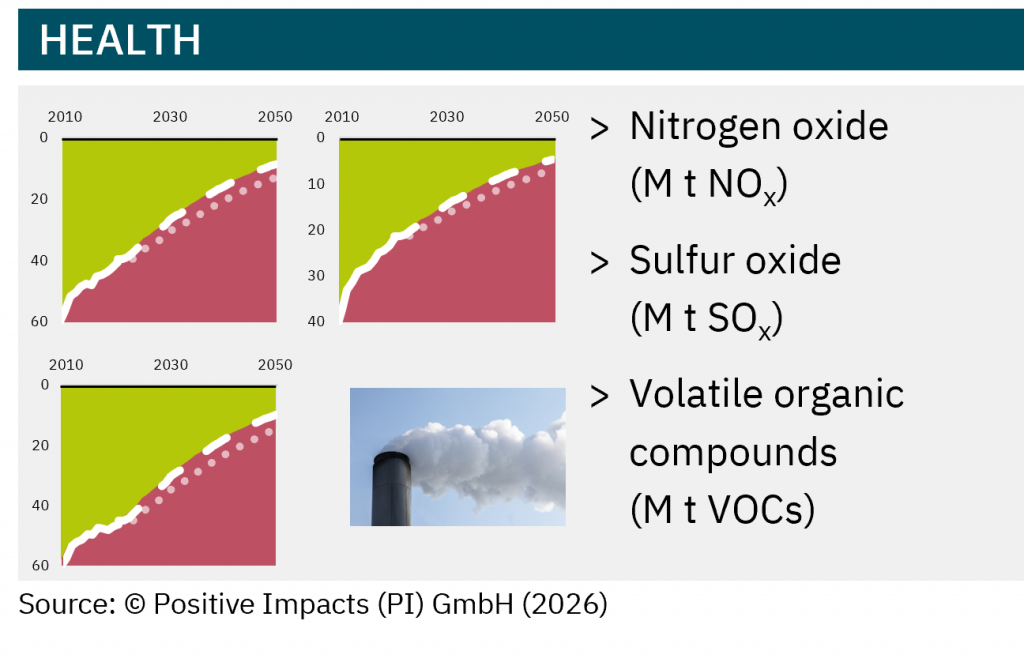
The PI Reference Path™ (PRP) for health enables science-based measurement and benchmarking of positive and negative health impacts.
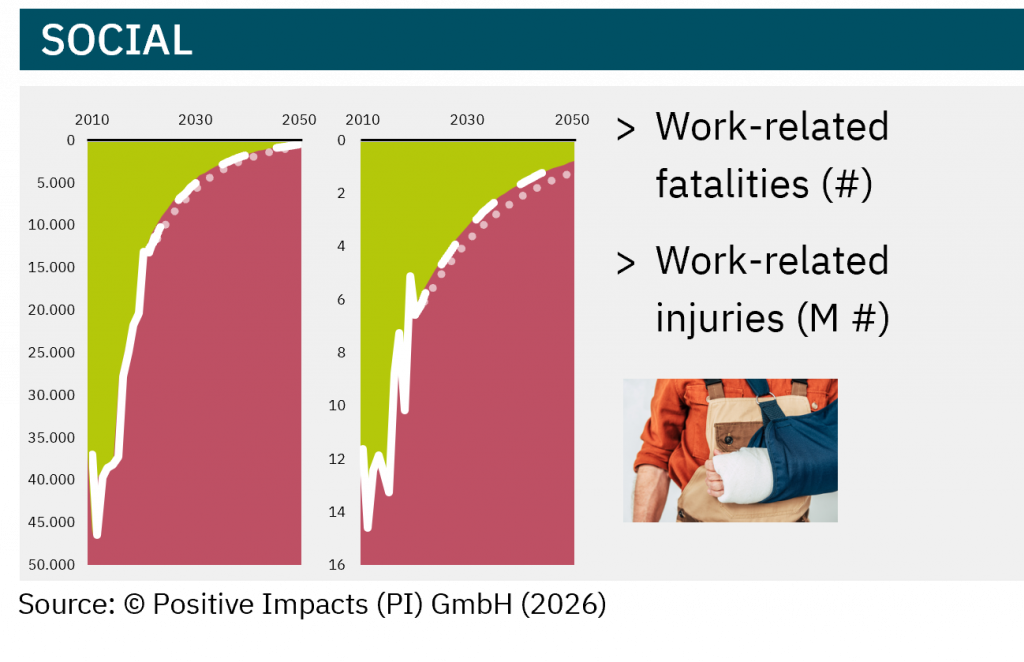
The PI Reference Path™ (PRP) for social matters enables science-based measurement and benchmarking of positive and negative social impacts.
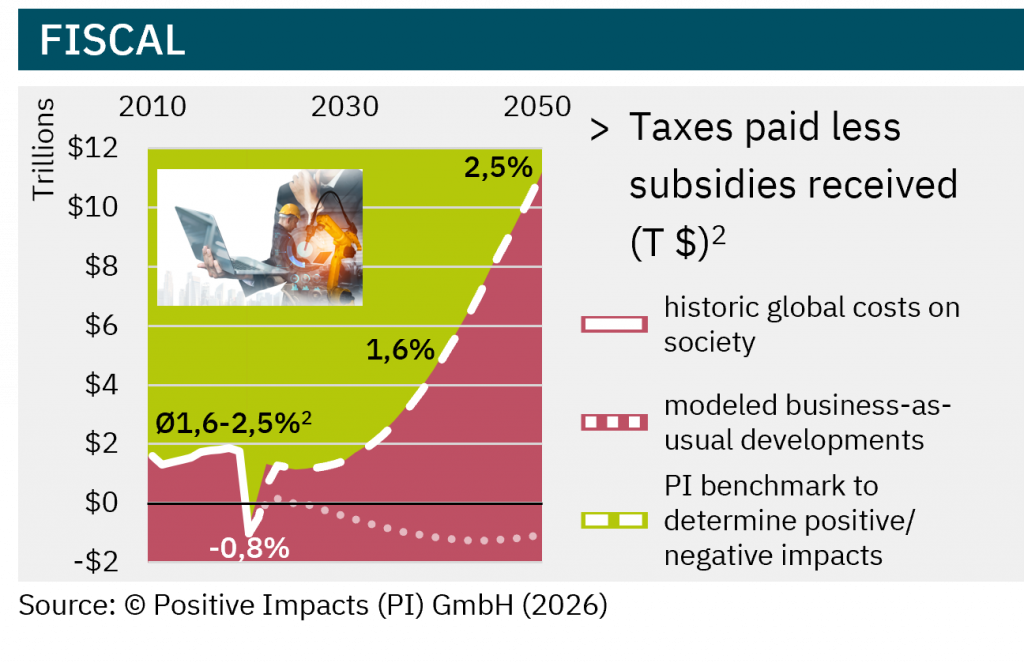
The PI Reference Path™ (PRP) for fiscal contributions enables science-based measurement and benchmarking of positive and negative fiscal impacts.

Our tool assesses both current and future impacts of your investments — across climate, water, biodiversity, health, social, and fiscal.

  • Current impacts show the actual effects of your investments in recent years
  • Future impacts project the performance of your investments based on trends, targets, and planned actions of you and your investments

All impacts are first quantified — in absolute values, percentages, or Impact Points™ — and then translated into clear performance levels. This makes complex impact data understandable, actionable, and easy to benchmark.

PI's 4 Impact KPIs: Together, these four KPIs show current performance, future performance, timing gaps, and climate pressure.

CURRENT IMPACTS of your investments — in % and Points/K€

Current Impacts show how your investments are performing today compared to the expected level for the current year — both in percentage and Impact Points™.
They quantify how close you are to full alignment with the PI Reference Path™. They:

  • Express performance as a percentage (−X % to +X %) and in Impact Points™ (P/K€), where 0 = full alignment
  • Weight impacts by their severity, so more significant outcomes (e.g. a fatality vs. an injury) carry greater influence
  • Translate impact gaps into time — “Progress Years” show how many target-years performance is ahead or behind (see next tabs)
  • Highlight strengths and gaps, helping you prioritize what matters most
  • Aggregate results across six topics: climate, water, nature, health, social, and fiscal
  • Enable benchmarking across sectors, asset classes and products of the financial services industry

After quantifying Current Impacts, each investment’s sustainability performance is classified into three main Impact Ambitionshigh, medium, or low.

These ambition levels reveal how your investments compares to the PI Reference Path™ and to the global average, showing at a glance whether they are leading, aligned, or falling behind.

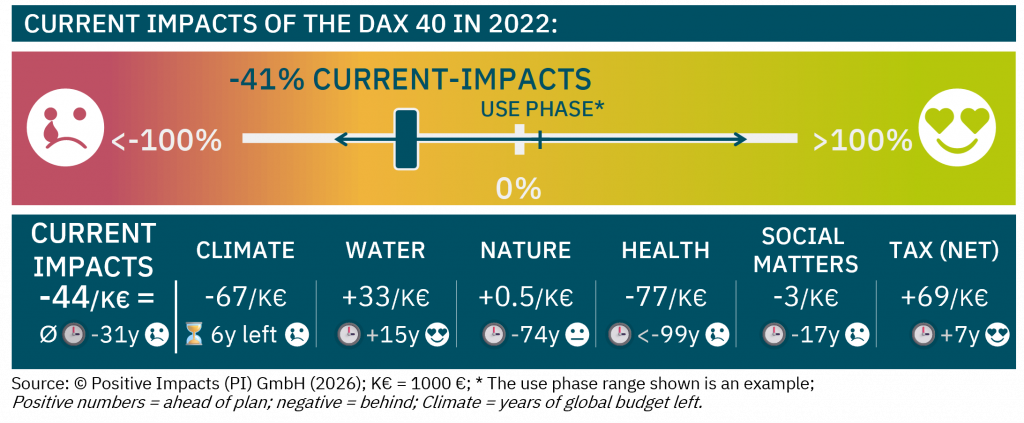
The CURRENT Impacts of the DAX 40 show overall negative impacts of -44 Impact Points/K€ revenue (-41%), covering operations + upstream for all indicators of the six topics while estimating missing data to ensure a complete picture

Climate Years left – for both current and future impacts

Climate Years Left shows how many years remain until the global 1.5 °C carbon budget would be used up — turning emissions into time. It

  • Answers the question: How many years remain until the global GHG budget for limiting warming to 1.5 °C is used up if everyone had the same GHG emissions as the company, investment, or product?
  • Can be calculated for current impacts (if today’s emissions stayed constant) or for future impacts (based on projected trends and targets).
  • If global emissions stay at today’s level, the world would exhaust the 1.5 °C budget in ~12.4 years.

This KPI complements our Impact KPIs — showing how emissions translate into time left within the global 1.5 °C budget.

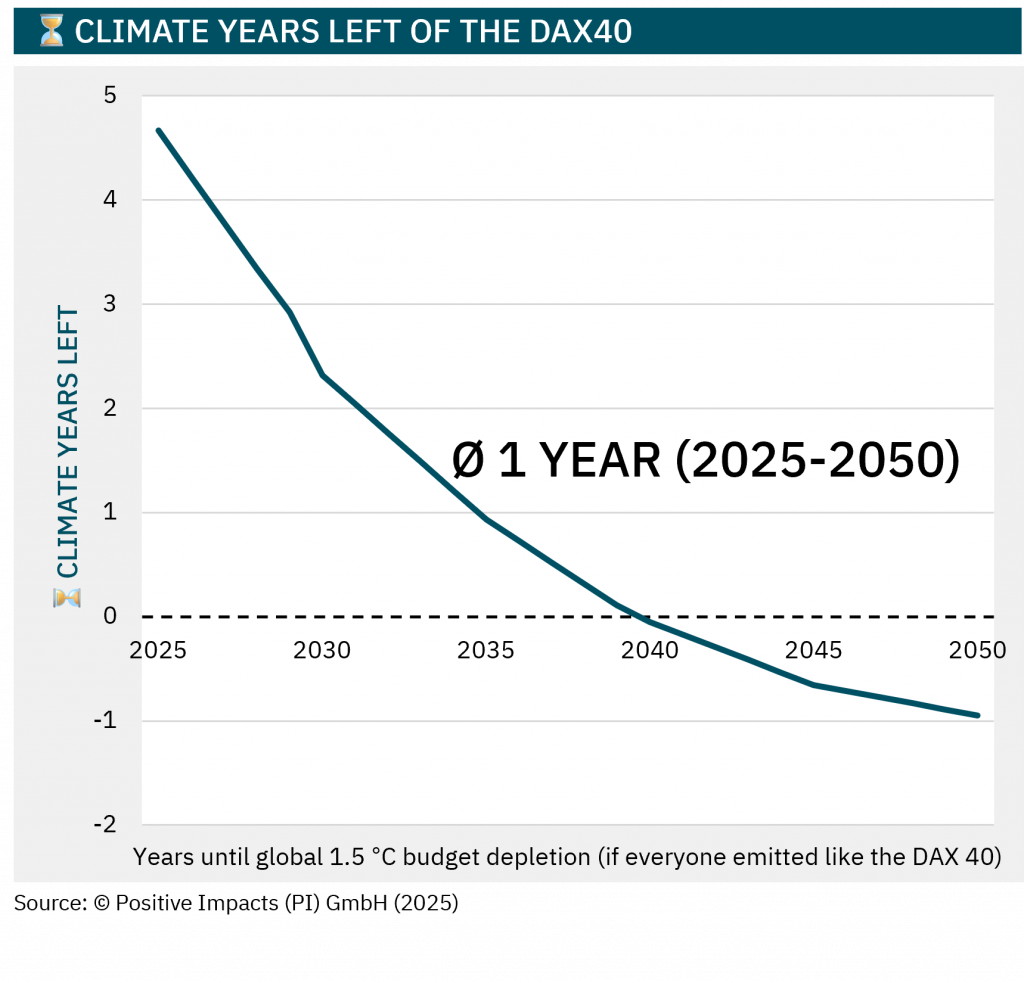
The Climate Years Left KPI translates corporate emissions into time left within the global 1.5 °C budget. The DAX 40 average from 2025 to 2050 is ≈ 1 year. The PI Impact Accounting Framework, Das PI Rahmenwerk zur Wirkungsbilanzierung

Progress in Years – how far current and future impacts are ahead or behind the reference path

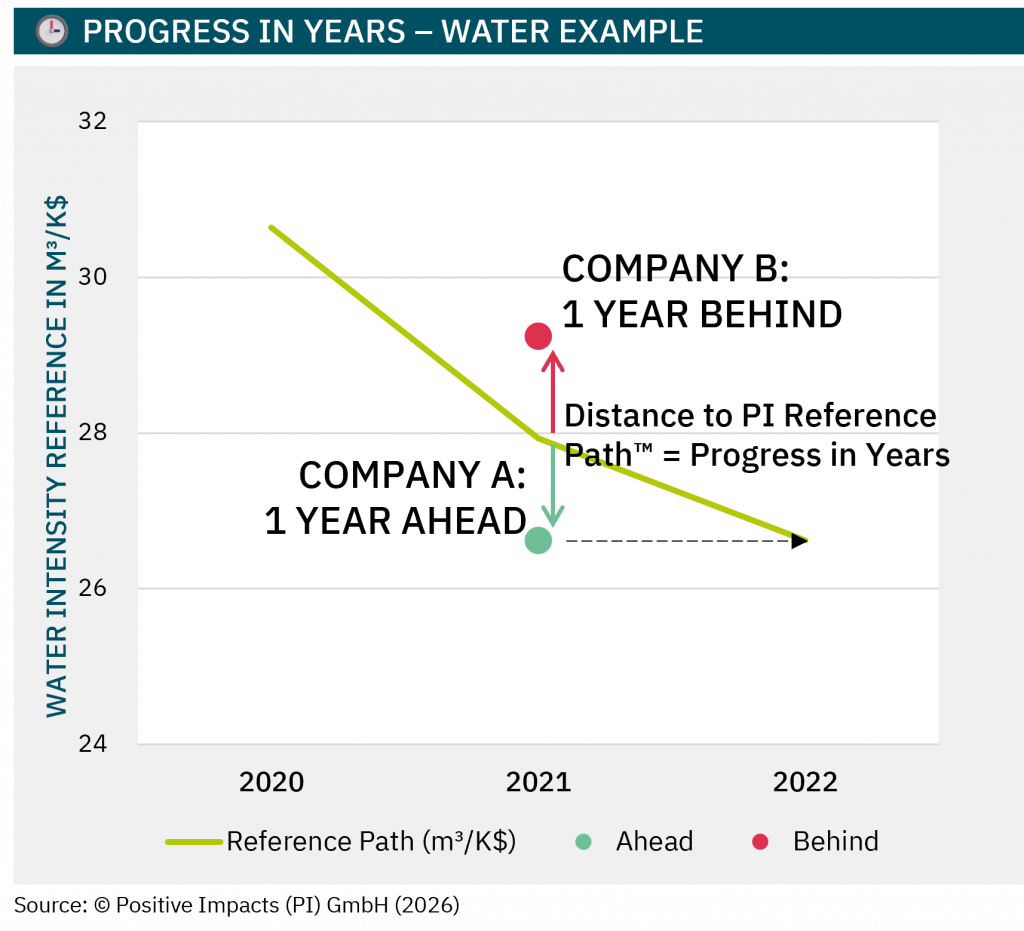
Progress in Years shows how many target-years performance is ahead or behind plan — turning impact gaps into time.

Progress in Years — for current and future impacts

  • Current Impacts (Progress in Years):
    Show how far each indicator’s current performance is ahead or behind its annual target — expressed in target-years.
    Positive = ahead of time, negative = behind.
    The overall result combines all indicators into a single weighted average of Progress Years, using their impact magnitude (Points/K€) as weights.
    It shows how far the organization, overall, is ahead or behind sustainability targets in time.
  • Future Impacts (Progress in Years):
    Show the average time gap between projected performance and the target path over the forecast horizon (e.g., 2025–2050).
    Calculated as a simple, un-discounted average of annual Progress Years:
    positive = ahead, negative = behind.

Together, these KPIs complement our Impact KPIs — translating performance and alignment gaps into time.

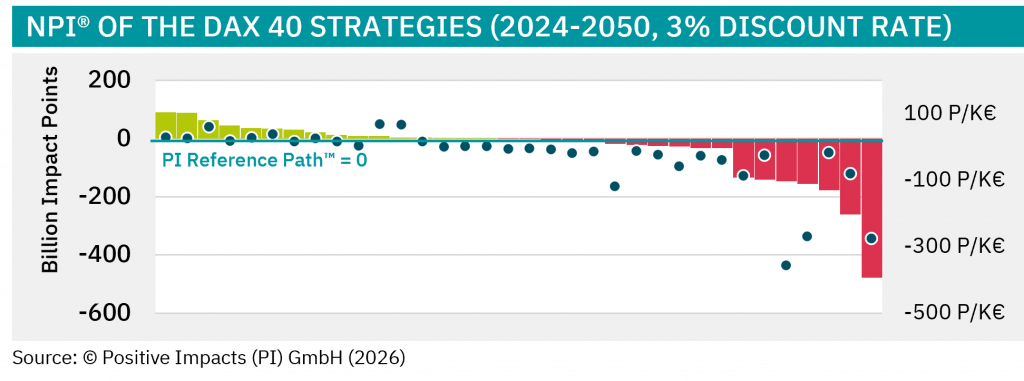
FUTURE IMPACTS (NPI®) — in % and Impact Points™

Net Present Impact® (NPI®) is a forward-looking KPI that projects your organization’s future impacts and expresses them in both percentage and Impact Points™, discounted to today.
Similar to Net Present Value (NPV), it gives greater weight to near-term actions and less to distant targets without clear milestones. It:

  • Discounts future impacts (e.g. 2025–2050) to present values, aligning them with the PI Reference Path™
  • Expresses results in percentage (−X % to +X %) and Impact Points™ (Points/K€), where 0 = full alignment
  • Weights outcomes over time, rewarding consistent near-term progress and realistic long-term goals
  • Enables benchmarking across sectors, activities, products, and value chains
  • Supports target management — benchmarking ambitions, identifying gaps, and setting Impact Ambition levels (High / Medium / Low)
  • Uses an open-ended scale, capturing both positive and negative net impacts

By translating long-term performance into both time-weighted percentages and discounted Impact Points™, the NPI® provides a credible and comparable view of expected future impacts — creating a clear bridge between sustainability performance and financial decision-making.

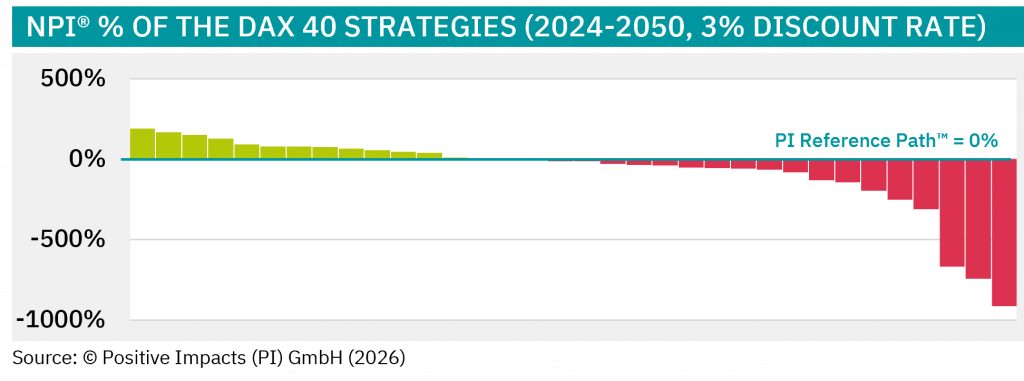
Future Impacts (NPI®) in % are calculated by dividing the Net Present Impact (NPI®) by the expected impacts under the PI Reference Path™ (PRP) over the same period.
Future Impacts (NPI®) in Impact Points™ are calculated by subtracting the expected impacts under the PI Reference Path™ (PRP) from projected future impacts over the analysis period. If projected impacts are better than the reference path, the result is positive; if projected impacts are worse, the resulting Net Present Impact (NPI®) value is negative.
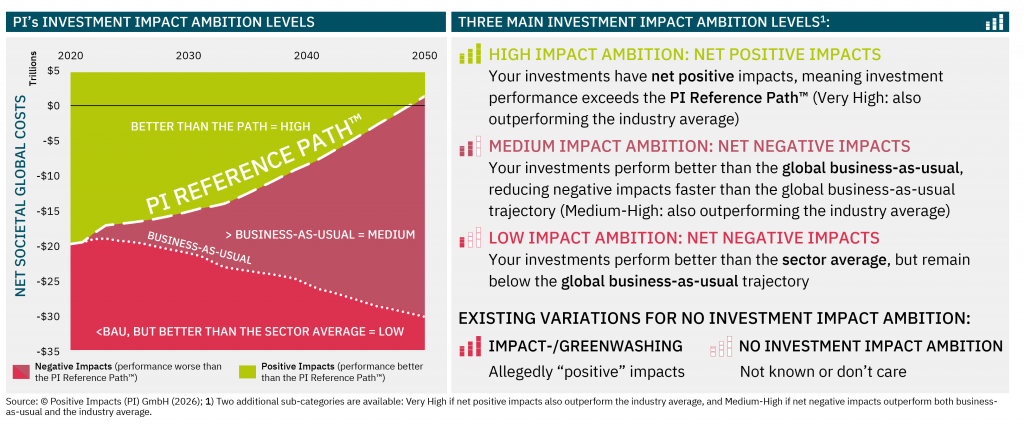
Investment Impact ambition levels

Once Current and Future Impacts of your Investments are quantified, results are classified into three main Investment Impact Ambition Levels — High, Medium, or Low.

This allows you to measure, compare, and align your investment activities with the ambition level you aim for, providing a clear benchmark for strategy and performance.

Three main Investment Impact Ambition Levels:High Investment Impact Ambition: the impacts of your investments are net positive; investment performance exceeds the PI Reference Path™ (Very High: also outperforming the industry average).Medium Investment Impact Ambition: the impacts of your investments are net negative, but investment performance improves faster than the global business-as-usual trajectory (Medium-High: also outperforming the industry average).Low Investment Impact Ambition: the impacts of your investments remain net negative and investment performance is below the global business-as-usual trajectory, but still better than the sector average. Existing variations for no Investment Impact Ambition:Impact-/Greenwashing: allegedly “positive” impacts.No Investment Impact Ambition: impacts are not known or not considered.

Ways We Support Your Impact Journey

Portfolio-level impact diagnostics

Gain a clear view of where your portfolio’s positive and negative impacts and related data gaps concentrate. Using spend-to-impact mapping and standardized data, you see which holdings drive the largest footprint and where stewardship or capital reallocation will make the greatest difference.

Impact materiality for investment decisions

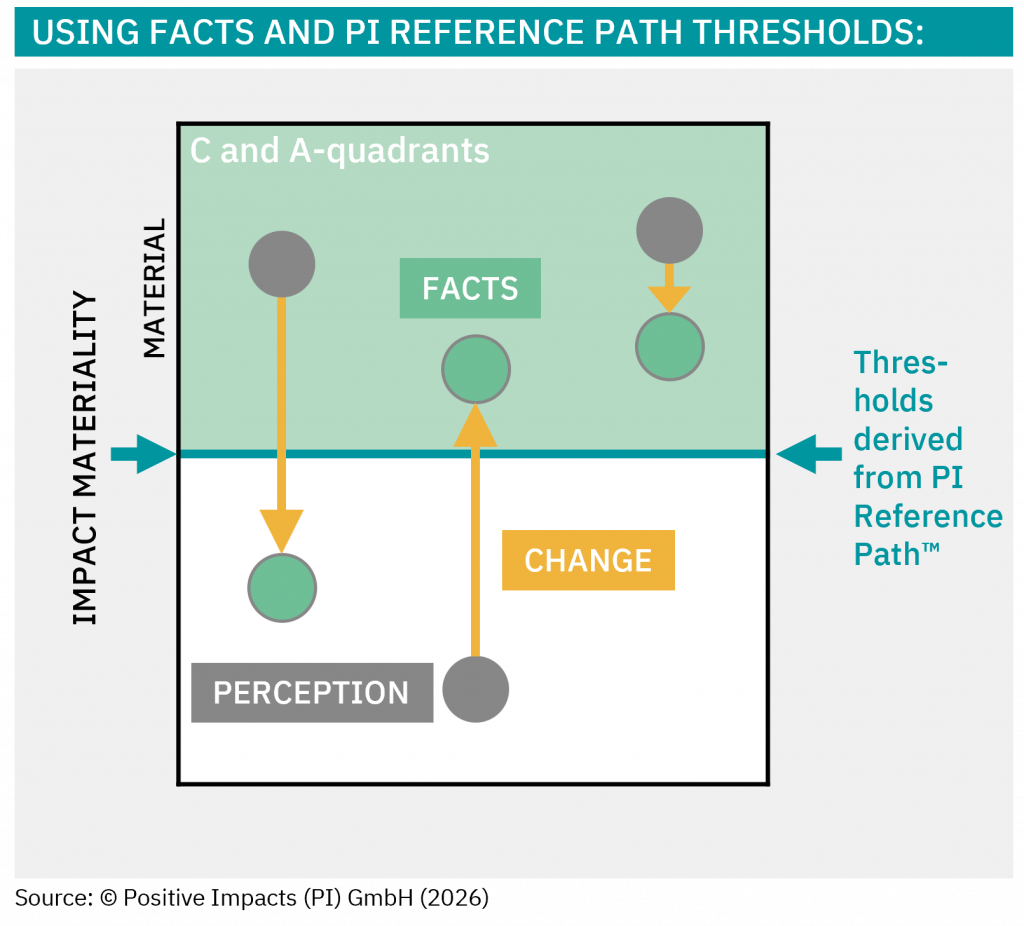
Identify the sustainability topics that truly influence investment performance. Our science-based thresholds automatically highlight which issues are material within and across sectors. Benchmarking against industry averages complements the sharper investment focus and engagement priorities.

Integration into investment processes

Embed impact indicators directly into investment workflows — from screening to due diligence and post-investment monitoring. This ensures consistent evaluation of sustainability performance alongside traditional financial metrics.

Active ownership and engagement strategy

Focus engagement where it matters most. Data-driven insights rank holdings by potential to improve impact and manage risk, giving (stewardship) teams clear escalation paths and measurable progress indicators.

Investor reporting and compliance

Produce credible, audit-ready disclosures aligned with CSRD, SFDR and institutional reporting needs. Transparent data and concise narratives strengthen investor confidence and support fundraising conversations.

Impact Materiality made measurable

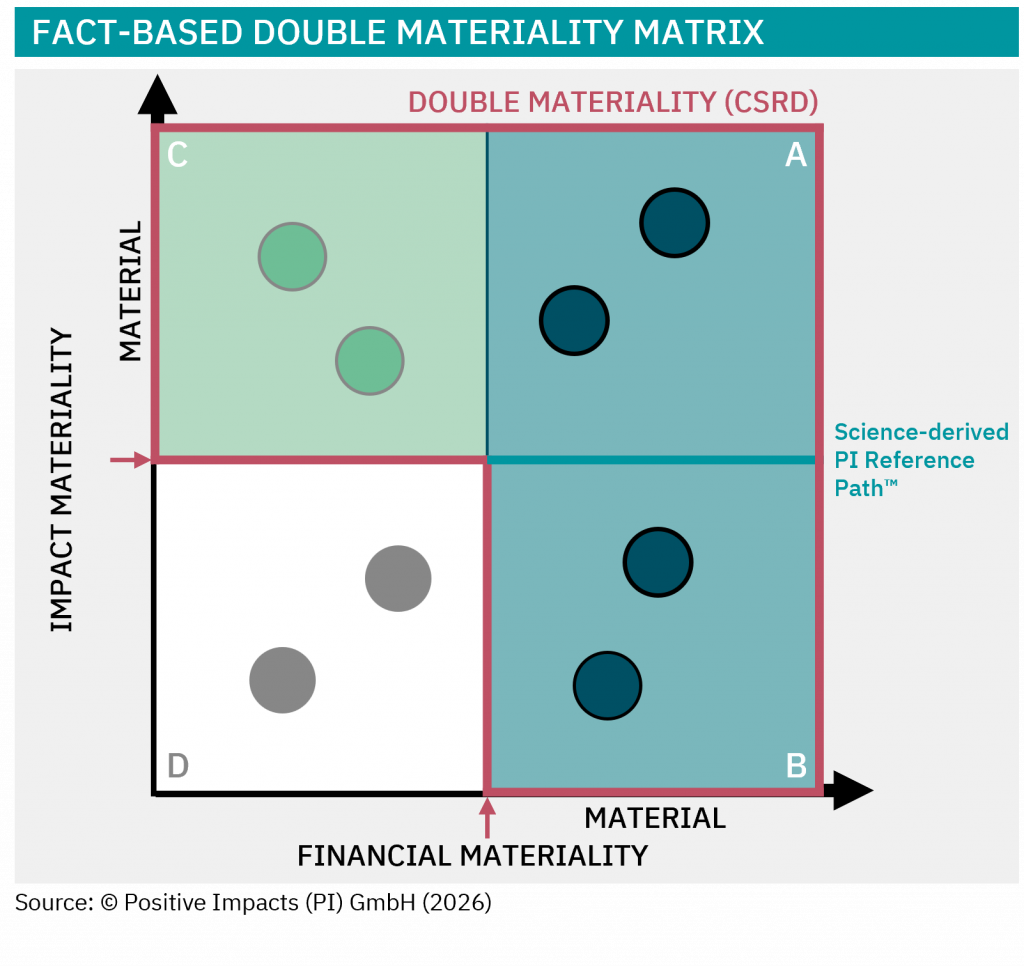
Impact Materiality assessments are the basis of any sustainability strategy and governance. We combine quantitative approaches with feasible stakeholder input to assess the positive and negative impacts of your organization and your investments on society and the environment.

Our fact-based double materiality matrix shows how we can apply our science-based thresholds onto any impact materiality scale, giving you clear objective results on your impact material topics (C and A) as well as a fact-based process to determine your financial material topics (A and B).

This ensures that your impact materiality assessment is not just compliant (if relevant), but meaningful. It helps you prioritize actions, allocate resources, and communicate with confidence.

Under CSRD, not only missing out material impacts, but also the reporting on non-material topics is non-compliant. We help you get it right – what to focus on – and go beyond.